The Unknown

The movie Duel is interesting only for one reason. It plays on our fear. There’s no character development, exchange of witty dialogues, deeply philosophical tones or unexpected plot twists in this movie. Yet it keeps the viewer hooked, solely by building up the tension. The viewer is scared about what is to happen next, as scared as David Mann who is being chased by a huge 18 wheeler.

What about the old rusty eighteen wheeler is so terrifying that it has kept generations hooked to this movie and made it into urban folklore? Is it its size, its speed or something quite entirely different? David Mann’s reaction, is what may be expected from anyone under the circumstance. It is clear to see that he fears for his life. But to the audience, there is something slightly more terrifying about this mysterious old truck.

The audience never gets to know who its driver is or why he is so intent on killing a man who overtook him. We wonder if the driver is mad, has a hidden agenda for killing him. We even wonder if the truck has a driver at all, maybe it is supernatural. The mystery behind who the driver is makes the movie all the more terrifying.

The things that terrify us the most in life are the uncertain. Will I get a job? Will I like it? Am I on the right path? Some people say their biggest fears are spiders, heights or small places. I believe, they feel so because they associate these seemingly harmless things to incidents of trauma, and that leaves them feeling helpless around the things that in themselves are harmless. A tiny spider on the wall could result in the feeling of absolute powerlessness for a forty year old man making him feel the same uncertainty you might feel before being pushed off a cliff.

You might argue with me here and “Isn’t our biggest fear in life dying? Yet what is more certain then death?”. This is a question I have often wondered about too and the only conclusion I came to is that death is a certainty shrouded by uncertainty. None of us know what happens after death, to think of it no one even knows how someone feels when he or she is dying and that itself, is terrifying.

In the movie David’s impulse tells him to run away from the truck the moment he understands what is going on. He speeds up his car and drives down a hill at 80kms/hr giving himself whiplash. Fear is often thought to cloud people’s judgement, the body goes into the fight or flight mode even before the mind can comprehend the situation. But I choose to believe that fear is a superpower. It has the capability to make us faster, stronger and cleverer. This isn’t just a quote from my all-time favorite tv series, but a theory supported by facts. Adrenaline literally turns us into superhumans. It is fear that keeps David from being hit by the truck in the first place. Fear acts as a pretty strong motivation in all of us. It keeps us from doing things that could potentially prove fatal.

It is the fear of failing that motivates most young professionals to put forward their best foot when they start working. However, sometimes we turn this small helpful warning voice into a monster and let it rule our lives. It is then that we lose our judgement and resort to irrational behavior. For example, in the current scenario, the fear of getting the corona virus is what is motivating us to follow the safety precautions. It is this fear that is motivating us to follow lockdown protocol no matter what our political alliances might be. But the moment we let this fear take over our judgement, we begin believing in pseudoscientific whatsapp messages claiming that symbolic gestures designed to lift our mood during the pandemic have the capability of killing the virus itself, we begin shunning people we think might be carrying the virus based on half-baked reasoning and attacking them in a counterintuitive attempt to end the pandemic.

The novel corona virus is unlike anything anyone has ever seen, a pandemic which is predicted to claim more lives than the First World War. The fear of the pandemic spread like wild fire and proved to be more dangerous than the pandemic itself in its initial stages. Since most of us knew next to nothing about the virus we all found ourselves speculating on what might have caused it. Articles containing misinformation went viral before the covid chose its next victim. The World Health Organization reached out to the masses offering them information about the number of cases worldwide and a list of preventive measures, but the fear of the unknown continued. Is the government suppressing data? Are there covid cases in my neighborhood that are being covered up? What is going on outside? While these questions are keeping some of us up at night, others try to find their escapes in homemade cupcakes and diy projects. But like the truck in the movie duel that relentlessly follows David wherever her goes, the fear of the Covid19 has made companions of us all.

SDGs

Ladies First, talks about the journey of Deepa Kumari, India’s best archer. Deepa had ranked no 1 in the world several times. However, something goes wrong when it came to the Olympics. Why was someone as talented as Deepa unable to win a gold in the Olympics? Did India provide her with the kind of support and the infrastructure she needs? The answer is no. Even the government officials accompanying them to the Olympics were treated better than Deepa and her teammates. The archers have no mental couch and no physical trainer or doctor with them, the only trained professional who accompanied them was their coach.

Women’s archery and women’s sports as a whole are largely neglected in India. This problem has its roots in the patriarchal mindset of India. Women are not considered to be cut out for sports and as such they aren’t given opportunities to compete. Only 1% of all women participate in competitive sports. On a higher level, this means that women’s sports gets less attention and funding than men’s sports and talented individuals like Deepa Kumari are unable to reach their full potential.

The film talks about United Nations Sustainable Development Goals 3 and 5. Goal three is good health and wellbeing. One of the foremost reasons for Deepa’s inability to win the gold was her sprain and her mental health. The institute neither ensured that their athletes would not suffer injuries before the games nor helped them cope with their mental health issues. Goal five talks about gender equality. Deepa tells us how little importance is given to sports women in India, how they hardly have enough funds and have to overcome obstacles at home in order to compete.

Interestingly Deepa Kumari said she trained at an institute set up by TATA. After Deepa came back from the Olympics, the corporation realized where it lacked and has decided to set up a fully equipped gym in the institute. It has also decided to hire a mental couch for the girls who are often under a lot of pressure to win.

The government and corporations can only combat this age old mindset by putting the “ladies first” when it comes to sports. They must promote women’s sports and create new opportunities for women to compete. Most localities have their own cricket and football training institutes, however they refuse to teach women who are interested in these sports, the government could offer rewards and recognition to those among them who change their policy and begin training children of all genders.

As for the less common sports like archery, the government should take stalk of the number of institutions there are and see if more need to be set up. Corporates could donate their funds to improve the infrastructure in these institutes and speak about supporting women in sports in their ads. While the second idea is not a csr activity and might help the companies increase their profits, they will be bringing female athletes and sportswomen to the limelight and give them the much deserved recognition.

Chasing Coral is a documentary by Jeff Orlowski, in which he attempts to create a time lapse of the coral reefs as they are bleached. The team is faced with a number of technical obstacles till they finally capture the horrifying visuals of the number of corals Australia lost in just one month. The team also unexpectedly captured another phenomenon on camera for the first time, the corals turning fluorescent right before they die. The film does a great job of explaining the phenomenon. They make the audience feel a connection to corals, an animal most of them did not understand.

The film speaks about SDG 13, climate action and SDG 14, life under water. Even a 2 degrees increase in temperature results in the death of thousands of corals as the plants living inside them are unable to make food when the water temperature changes, effectively starving the corals over time.

Little known to most people India has a number of coral reef formations. The major formations are in the Gulf of Mannar, Palk bay, Gulf of Kutch, Andaman and Nicobar Islands and Lakshadweep Islands. Marine biologists know that these reefs are being destroyed at an alarming rate. However, there are no up to date numbers and figures. No one knows where the impact is the worst. The lack of advanced technology makes it hard to monitor these reefs, India is just not doing enough to save them and most of us are unaware.

The Indian Government has set up 36 Marine Protection to protect marine life in India, 5 of these are for the protection of coral reefs. While there are laws in India to combat coral mining, no law can save the corals from the effect of climate change.  On the recommendation of National Committee of Mangrove and Coral Relief, Ministry of Environment and forests had set up an Indian Coral Monitoring Network. However, due difficulty in monitoring underwater conditions, vulnerable areas haven’t been identified yet.

The government can encourage Coral farming since 90% of the world’s corals will be at threat by 2030s. The government could also promote activities that do not harm the coral reefs but raise awareness about them. For example clear floored row boats could be used to take tourists on a ride so that they can enjoy the beauty of the coral reefs from a distance.

Plastic Ocean is another documentary that focuses on the SDG 14, life under water. However in this film also emphasizes on how the life under water impacts life on land (SDG 13). The documentary is rather graphic and shows images that will stay with the viewer for the rest of their lives, baby sea birds dying because their parents accidently feed them plastic shards instead of fish, their stomachs being cut open to reveal nothing but pieces of plastic.

As the documentary points out, there is a fundamental problem with how we function, how can everything that is disposable be made of a material that simply doesn’t break down? In 2018 alone 359 million metric tons of plastic was produced, and most of this plastic found their way into the ocean.

The government of India has banned plastic bags in certain areas, but that simply isn’t enough. Firstly these laws are loosely monitored in corner stores and market places in most states, secondly even if you do carry a jute bag to a shopping market, chances are you will come home with some amount of plastic in the bag. Corporates could sponsor research into alternative packaging options, however, there are already a number of such options available. People have discovered bio degradable plastic and even glass bottles are a more ecofriendly solution. The government could exempt taxes for fmcg companies who decide to choose a more eco-friendly packaging option. In fact they should even be exempted from the compulsory CSR spending since right now, this is one of the most important things they could do to save the planet.

The Devil Wears Prada

10 Life Lessons Inspired by The Devil Wears Prada — Spark Magazine

The Devil Wears Prada is an iconic film about a woman who has just entered the workforce. Andrea Sachs who wants to be a journalist finds herself at an interview at a fashion magazine and gets selected as the editor’s assistant. Needless to say, this is not the job she was hoping for. Andrea doesn’t care about fashion, and finds her colleague’s obsession with being skinny ridiculous. More over her boss, Miranda, the devil, is not easy to please.

Tired of Miranda being disappointed with her Andrea makes a few changes to her personal life in order to fit in better at her office space. She begins to wear designer labels and begins to put her career before personal relationships. She begins to understand the charm of the fashion industry. Andrea is on the path to becoming a tough career woman who is ready to go to any extent to rise to the top. However, when Miranda tells her how she manipulated the system to remain chief editor, sacrificing one of her best and most loyal employees in the process, Andrea realizes that this job just isn’t meant for her.

Jobs are often not what we expect them to be. Oftentimes our expectations of the career we choose are built up over time from the movies we watch and books we read. We began to imagine teachers, doctors, engineers, nurses and journalists as heroes. However the ground reality is very different. The job we have to do may actually be pretty tedious, boring and monotonous.

In films about journalism, the journalist is often shown as someone discovering secrets, the weight of the world often rests on his or her shoulders, and they decide what they want to write and what gets published. The journalist in films is an all-powerful one man army.

However, in real life, tasks are fragmented in newspaper organization and divided between people. The assigning editor’s only job is to assign stories and check whether all important points have been covered by the reporter. The reporter simply gathers information and puts it down in a workable structure. The sub editor is the one who fashions this structure into a story.

At a recent internship with a data journalism website, I was lucky enough to have the most reasonable and understanding seniors to work under. The work seemed exciting when I heard about it and it seemed like a good way to play my part in making information accessible during a crucial social movement in India.

However, since a large part of my job consisted of collating data, the job began to seem pretty monotonous after a few weeks. However, at the end of the week, as I saw all the data about isolated events I had collected, put into numbers and painstakingly verified, beginning to form a bigger picture, I realized what I was doing was important.

No job is as glamorous as it seems from the outside. But when we select a career that we believe in, no matter how tedious our job might seem sometimes, we can remind ourselves that we are part of something important. We should remember that every little step in the process is important, and whatever role we play in a company it is essential for the company’s success and do our work well.

Office Space

In office space we see a scenario we are all too familiar with. Three men who hate their job but cannot escape it.  They resort to the most ridiculous measures to fix the most mundane problem. Peter Gibbons, one of the three young software engineers, tries to seek help from a hypnotist. The hypnotist suddenly dies before helping Peter snap out of his trance. A strange kind of relaxation comes over Peter after the incident and he simply stops caring about anything. He then convinces two of his friends who are soon to be fired to install a virus in the system of the company they are working in to transfer small amounts into their banks. However the scheme fails. Their problem surprisingly has a much simpler answer. While his two friends join another IT company and submit to the same boring, reward less routine, Peter, finds a job that he actually likes.

Doing what you love and loving what you do is very important to keep one motivated. Thinking about what gets you excited before choosing a career helps, but it isn’t enough. It is always a good idea to go for an internship to see what it is actually like to be a part of a company before you join it. Moreover, it ‘is important to look at the kind of ambiance in a particular company before joining it. For example, a young fashion designer might feel elated when a famous brand hires her, however, the job might turn out to be a nightmare if her sense of style doesn’t match that of the company. Therefore understanding the company is important, not just to help one clear an interview but to make sure they ae making the right choice.

While some companies such as Goggle expects employees to be creative, others expect them to stick to the beaten path. Only companies who are willing to take risks encourage creativity at workplaces. However, today the number of such companies has increased exponentially. Especially in a place like Bangalore, many startups have a work atmosphere that encourages and rewards innovativeness. All this being said, beginners do not really have much choice and most of the time they are expected to work mechanically conforming to required rubrics, careful not to go against set patterns or defy company tradition. However once they reach a position of esteem they do get to make a choice to be more creative. Thankfully there are thinking individuals who hold on to their uniqueness, their passion and brilliance in spite of being in a mundane work environment. They are the ones who make a difference and manage to take their company to new heights. Just look at Shekhar Gupta, the editor of Print who channeled all his experience and passion for journalism into the new age online journalism portal that takes a completely new approach to journalism.

Often times people simply see their job as a way to sustain themselves and begin to hate the company they work in. In reality often a person’s objective is in conflict with that of the company he or she works in. The employee want to get paid as much as possible while having to work as little as possible, the company on the other hand wants to pay them as little as possible while extracting the maximum amount of work they can. For a company to be to be truly productive, each employee must believe in the work they she or she does. An employee must believe that the work a company is doing is meaningful and important and he or she as a part of the company is playing and important part. The company on its part must treat its employees as an integral part of its mission. It must give them employee benefits and keep them motivated. It is only then that a person’s personal objective is aligned with that of an organization.

Management Midst Madness

The Covid19 is the biggest pandemic our generation has seen. There virus is so new, there are no vaccines and no proven cure, in fact, no one even knows how the pandemic began. Yet governments around the world must work to keep their countries in order and get through the disaster while minimizing damage. Hospitals must work day and night to identify cases, isolate them and try every possible medicine that could cure the patients.

Image result for covid 19 usa cases timeline

With a highly interconnected world, it is impossible for a country to be unaffected by the COVID 19. On 31st December 2019, a never seen before pneumonia was detected in China’s Wuhan province. Soon, medical experts realized that the pneumonia was caused by a type of Corona Virus that had jumped from animals to humans. The virus transmitted easily from one human to another, making it extremely contagious. By January 30th the Novel Corona Virus had given rise to a Public Health Emergency of International Concern. As of March 20th, 2020 , has reached approximately 140 countries including China, but tested negative in at least 11 countries, as of 17 March, ruling out the earlier suspected cases.[1]

Any country that is not completely cut off from the rest of the world is at risk from Covid19. Each country has had to come up with its own way of managing this crisis based on the resources available to them.

Image result for corona virus timeline

Though China, as the country of origin, was worst hit by this crisis in its initial phase, it has set an example for other countries with its effective management of the crisis. When put in a tough situation one must be tough, and China, whose draconian governance style is often criticized for its disregard for human rights achieved what individualistic USA couldn’t. Initially, China was criticized for its lack of transparency on how it was dealing with this crisis. But Xi Jinping was quick to realize the scale of the problem. China has been the only country so far to be able to impose a total lock down in affected areas. Public transportation was stopped, roads were blocked and all movement including that for personal and medical emergency was prohibited. Moreover, door to door monitoring was started in the Wuhan district and suspected cases were forced into isolation. While these measures seem rather dystopian, they were effective in establishing total control over the movement of people in affected areas. Doctors and hospital staff went on “suicide missions” to treat those affected in the Wuhan district and proper treatment was provided. Wuhan and other effected cities went into lock down on 23rd January and since then the number of cases have been rapidly falling. Hubei province has recently reported no new cases of infection implying that the condition I China might actually be stabilizing.[2]

However, all this has come at a huge cost. The forced isolation and restrictions on movement in emergencies are a direct assault on one’s human rights. The utilitarian would say that it is all justified since it serves the greater good, however photos from the province and stories about how people were locked up against their will continue to haunt us.

Image result for russia covid 19
Covid19 cases in Russia

In Russia, Putin has only recently discovered the implications of COVID19. Russia took the first step of shutting down its borders as late as 18th March. The authorities who were previously confident, pointing to only 147 confirmed cases and zero deaths, out of more than 116,000 tests for COVID-19[3] in the country of about 145 million people—one of the lowest ratios among infected nations in the world, have now come to realized how contagious the virus is.

This story is only too familiar. USA for one seemed to be in a state of chaos. Donald Trump recently admitted that he did not realize that a flue could actually kill someone, the price of the tests turned out to be too high for the government to pay and the number of tests done was abysmally low. To make matters worse he appointed his deputy Mike Pence to oversee America’s response. Mike Pence who lacks any kind medical qualification only worsened the amount of trust the US populace had on the government. Trump’s decision to ban all travelers from the European Union, excluding those travelling from UK only raised further questions.  USA suffered from utter mismanagement. The public lost faith in the government who was neither efficient in containing the virus, nor in spreading awareness about it. It carried out only 5 tests per million citizens as compared to South Korea’s  3,692 tests per million[4]. As such, the number of cases detected is suspected to be much lower than the number of total cases, putting a large proportion of the population at risk.

However, Trump’s government has been doing all it can to manage the public relations crisis and to ensure that Americans continue trusting the government in times of crisis. Trump has assembled a team of experts to look into the situation and he and his team holds a press conference every single day to answer questions related to the novel Corona Virus. A study by Imperial College in London used modeling to predict that 80% of Americans will get infected and 0.9% will die if nothing is done to lower the rate of infection in the USA. The study recommends hardline measures such as compulsory isolation in order to lower the rate of infection. The USA has taken this study very seriously and addressed all concerns related to this report. The USA has established complete transparency by telling its citizens that there is no proven cure for the virus. They have listed out a number of drugs which have been effective in fighting the virus around the world and have allowed the use of trusted drugs such as Chloroquine which have no harmful side effects.

When it comes to management during the Covid19, failure stories are more common than success stories. However, one story that must be studies is that of Italy. Italy’s Covid19 death toll crossed China’s on 19th March. Italy has one of the world’s best healthcare system and it was quick to act closing down the border on 30th April, the very day the first cases were identified. So what went wrong? Initially Italy had been testing everyone in contact with infected persons. However, as more cases were discovered, this became impossible and only those with symptoms and in contact with an infected person was tested. As a result asymptomatic cases were ignored and the virus spread through the country. In fact   due to the testing system, people who had all the symptoms but were unlikely to have come in contact with a foreign virus were not tested. A young anaesthesiologist broke the rules to test,  Mattia, a 38-year-old Italian from the small city of Codogno, in Lombardy, who was hospitalised for a severe case of atypical pneumonia. He tested positive for coronavirus even though he had not travelled to China nor had any contact with people coming from Asia exposing the fault in the system. Codogno was the focus of a local outbreak of the disease: new cases were identified in the following days and the whole area was put under strict quarantine for 2 weeks. But it was too late. Overlooking the minutest detail during a crisis can be detrimental, and the Italian government had overlooked a major fact, infected people may not show symptoms for up to 14 days.

Image result for italy coronavirus infographic

While the high number of cases in Italy may be attribute to severe mismanagement, the high mortality rates could be because of a different reason. Italy has the 5th highest average age in the world and a high life expectancy. This implies that a large part of Italy’s population is above the age of 60 and this is the age group most likely to succumb to the virus.

Image result for india coronavirus state wise
Covid19 cases in India

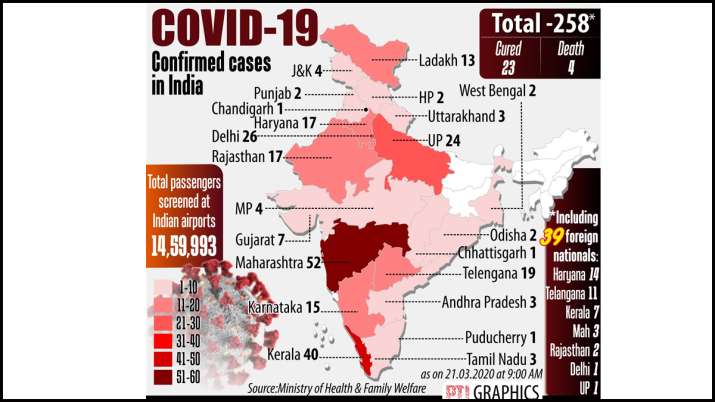
In India, a lot has been done to combat the virus right from the early stages. Travel has been shut down pretty early and schools have been shut down before India arrived at the community outbreak stage. So far 360 cases have been identified in India and more hospitals are being authorized to treat patients with the corona Virus. The PM just announced a lock down to tackle the rising number of cases and to stop India from entering the community outbreak stage. People travelling back to India from high risk countries are being screened and quarantined. And asymptomatic high risk patients are being screened twice to ensure they are truly negative. The Prime Minister’s rather unconventional idea of getting Indians to clap and beat utensils at a designated time got an overwhelming response today and people seem to be in jovial spirits in spite of the lock down.  

Yet snags in the system lead to fatal mistakes. For example, recently in West Bengal, a bureaucrat’s son returning from UK was allowed to enter Kolkata without undergoing the screening process. The 18 year old boy visited several places in Kolkata for the next two days before he began to show symptoms of the virus and tested positive proving to be the first case in the city.

While the Indian government tries to tackle the medical emergency, a different kind of crisis seems to have emerged, one of misinformation. Amidst the panic, people have been falling prey to misinformation, and rumors from unverified sources. The possible execution of a Covid 19 patient in North Korea, has got Bangaloreans panicking. People have been running away from hospitals before they can be tested since they believe they will be killed if detected with the virus. This is an utter mismanagement of information. On a lighter note, PM Modi’s address to the nation to be cautious of the corona virus and instructions to clap to thank our health care workers, seems to have given people the idea that clapping gives out positive energy which keeps the virus away.

There have also been accusations against the government for trying to “hide deaths due to the virus” by stating that the patients died due to a combination of diseases. Moreover, questions are being raised about the official figures. Soutik Biswas from BBC believes that the low numbers are merely a result of the low number of tests being carried out. He also implies that the lockdown and the decision to close public spaces indicate that the government is aware that the problem is much more serious than the figures show. Are we then making the same mistake as Italy?

What is needed at this hour is a greater deal of transparency about how the cases are being treated and efforts to make people trust the healthcare system. The government hospitals in India already have a bad name and while the government can win public support by giving them a reason and a way to celebrate while in isolation, convincing the same people to get tested in the hospitals they dread is not an easy task.


[1]  https://www.pharmaceutical-technology.com/features/coronavirus-countries-tested-negative/

[2] https://www.theguardian.com/world/2020/mar/19/chinas-coronavirus-lockdown-strategy-brutal-but-effective

[3] https://foreignpolicy.com/2020/03/18/fortress-russia-coronavirus-spread-covid-pandemic/

[4] https://www.lowyinstitute.org/the-interpreter/covid-19-china-us-india-comparative-crisis-management-101

India’s Performance on SDGs

-Anuksha Dey

The sustainable development goals (SDGs) are a set of 17 goals formulated by the United Nations in 2015 to provide “a blueprint to achieve a better and more sustainable future for all”. India has always played an active role in upholding the SDGs, right from their inception. Other than pre-existing policies such as Beti Banchao Beti Padhao and MGREGA, which are in line with the SDGs, India has come up with a set of new policies to help them meet the specific targets mentioned in the SDGs.

SDG 6, clean water and sanitation, has been a priority for the Indian government. Along with the Swacch Bharat Mission Grameen under the department of drinking water and sanitation, the government introduced the Namami Gange Mission. The Namami Gange Mission was launched as a priority programme with a budget outlay of Rs.20,000 crores for the period 2015-2020. The targets of the this project included sewerage project management, urban and rural sanitation, tackling industrial pollution, water use efficiency and quality improvement, ecosystem conservation and Clean Ganga Fund, among others.

SDG 3, good health and wellbeing is extremely important for a developing country such as India. The government has introduced a gamut of policies to this end. The National Health Policy, 2017 has specified targets for universalising primary health care, achieving further reductions in infant and under-5 mortality, preventing premature deaths due to non-communicable diseases as well as increasing government expenditure on health. In 2018, the government also introduced the Ayushman Bharat or the National Health Protection Scheme. The scheme is supposed to cover over 10 crore poor and vulnerable families providing coverage upto 5 lakh rupees per family per year for secondary and tertiary care hospitalization.

According to Dr. Mukund Rajan, the chairman of Environment Committee of Federation of Indian Chambers of Commerce and Industry (FICCI),  the SDGs provide companies “unparalleled economic opportunities through new business models and innovative growth strategies that are focused on purpose-led and long-term value creation”. Corporates in India are increasingly aligning themselves with the SDGs. FICCI claims 85% of their member companies are working towards the SDGs that are directly linked to their business. For example Tata Steel has undertaken a project to improve sexual and reproductive health and well-being in adolescents in Saraikela Kharsawan district of Jharkhand, in line with SDG 3, Good Health and Wellbeing. Tata is setting up Youth Resource Centers in Jharkhand to provide training on health and reproductive issues in order to do this. State Bank of India too has reached out to villages though its Youth for India program. It is setting up community-run solid waste management systems in the villages of Rajasthan in line with United Nations SDGs 11, 13 and 17 (sustainable cities and communities, climate action and partnerships for the goals). Ambuja cement, Tata Motors, HSBC, and Coca Cola are a few other well known corporations which  have aligned themselves with the SDGs.

India seems to have done a good job meeting its goals as far as numbers are concerned but the ground reality is very different.

Some of the government schemes have their drawbacks as well. The Pradhan Mantri Ujjwala Yojana, was formulated in 2016 to make clean fuels accessable to households under SDG 17, Sustainable and Clean Energy. Over 22 million families have been provided with Liquefied Petroleum Gas connections under the Pradhan Mantri Ujjwala Yojana 2016. However, the scheme makes lpg cylinders accessible instead of replacing them with cleaner sources of energy While toilets have been installed around India many of them do not have proper sanitation facilities and many areas still lack access to electricity.

 For India the hardest to achieve goals have been the ones that require a change in people’s mindsets. Being a largely patriarchal society, achieving SDG 5, Gender Equality, seems like a far cry. Furthermore in a country as diverse as India achieving SDG 10, reducing inequalities, too seems almost impossible. Not only is India plagued by economic inequalities, it is troubled by caste inequalities, which have been embedded so deeply in Inidia’s culture, they have become a part of it. India’s cultural, social and religious diversity has often led to conflict between different groups and with communal attitude on the rise India seems to be moving further and further away from SDG 16, 16 peace, justice and strong institutions. Goal number 13, climate action too can only be achieved through a change in mindset brought about by greater climate consciousness. These are goals which require a bottom up approach instead of top down policies. They can only be achieved over time through grass root level social workers who understand people’s concerns and work slowly to change their mindsets.

India should not focus less on these goals simply because these goals are harder to achieve, in fact they need more sustained, more rigorous policies. However, as a developing nation, India’s first priority must be to meet the basic needs of people. As such, I believe, India must try to meet the No Poverty, Zero Hunger, Clean Water and Sanitation and Quality Education goals by 2030. As for Gender Equality, reduced inequalities, climate action, and peace, justice and strong institutions, India must come up with sustained long term goals which we should continue working on even after 2030. These are pertinent social problems that may take time to solve, simply meeting targets should not be the priority in these cases.

Corporate ethics in the movie Insider

Corporate ethics is an umbrella term that refers to the principles that help deal with moral or ethical problems that arise in the work-space. However, the term may be more problematic than it seems.

Corporations are considered legal entities separate from the entity of its owner, as such a corporate is not human. At the same time corporations, being big business organisations, by definition have a large amount of power. As such a separate set of ethical standards from corporations could potentially mean what is unethical for an individual might just become the norm for corporations. This is exactly what we see in the movie Insider.

The “seven dwarfs”, or the seven biggest tobacco companies have been claiming that their product is not addictive while their researchers have proved otherwise. Wigand, is torn between his ethical obligation to his company, to honor his contract and not reveal the findings of his research, and his moral obligation to inform the world about a potentially dangerous product. Wigand decides to put everything at stake to tell the world the truth about his employers.

What Wigand does in the movie is known as whistle-blowing. A whistle-blower is a person who informs on a person or organization regarded as engaging in an unlawful or immoral activity. Whistle blowing may be thought to be a violation of professional ethics especially when a confidentiality agreement has been signed. However, the whistle blower often sacrifices his professional ethics for the greater good. Whistle blowing is considered ethical in situations where keeping the information to oneself would cause considerable harm to the public and where the information concerns something that directly affects the public. For instance, Edward Snowden, the man who exposed USA’s breech of personal privacy, is almost considered a hero around the world.

In the movie it is easy to see that there is a nexus between the government, corporate entities and the media. Though not explicitly stated, the government does not probe into the accusations against the tobacco companies, the FBI agents seem to be completely on the side of the tobacco companies when Wigand calls them for protection. The media house is scared that the tobacco company will buy them over if they play a video that threatens them making it clear that the notion of a “free press” is but a lie.

In India the nexus between the three is no secret. The best and the biggest names in the press are owned by the biggest names in the corporate world. We have the Birlas with their huge stake in TV today and the Ambanis owning the Network 18 group. Most media houses in India is clearly recognized by their political stance (read political bias) Reporters Without Borders recently released a report tracking a few of them, in the report they go as far as to call a certain Tamil newspaper “DMK’s mouth piece” and a certain Bengali Channel “CPIM Bengal’s unit”. The whole report can be read at https://india.mom-rsf.org/en/findings/corporateownership/ . But it does not take a genius to spot the inherent biases in many of these news channels, biases that can only be a result of substantial pressure on the editor to abide by what the businessmen, the politicians and the businessmen-politicians say.

Perhaps in such times men like Jeffery Wingand and Lowell Bergman who put the truth about everything else can not survive but just maybe, some of them do manage to stray true to their ethics while navigating a corrupt world.

Bridge Over River Kwai

            Management becomes most important during crisis situations. For people in management positions, dealing with each crisis is often like fighting a war one must be disciplined and manage the group well making sure everyone is motivated even though the situation might not be favorable. The manager must ensure that he is respected and is able to maintain positive thoughts so that we can keep those working under him motivated. At the same time he must ensure that the team is constantly working towards meeting all targets. How a manager does this depend on his management style.

Leadership under adverse/hostile conditions

 In the movie Bridge on the River Kwai we come across two leaders in two different situations with two very different leadership styles, Colonel Saito and Colonel Nickolson. However, both of them are dealing with crisis situations. Colonel Nickolson’s army has been ordered to surrender to the Japanese and now must serve their time as war prisoners under Saito who exploits the soldiers and officers for manual labor. Colonel Saito on the other hand will be forced to commit suicide under the Japanese army code if he is not able to build a temporary bridge over the Kwai Yai in Thailand by May. He must make use of the British forces in his captivity to do so, however, the British see him as a mad dictator and seem to celebrate his failures instead of working to build the bridge.

Saito and Nickolson being very different people have different approaches to the crisis. Saito’s goal is to build the bridge and he wants to enlist all men available for the manual labor. He adopts a reward and punish strategy where he rewards the soldiers with days of rest as well as gifts to keep them going. He fires those who prove inefficient, including his own engineer and takes the project into his own hands. He punishes Nickolson and the officers who are unwilling to work by imprisoning them for days. Saito is in short what is known as an autocratic leader in the world of management. As pointed out by Nickolson later, his methods prove largely inefficient. What might have gone wrong then? The simplest and the most obvious answer is that in spite of his efforts to appear lenient, Saito is unable to win the respect and loyalty of those working under him. He continues to call the soldiers war prisoners, humiliating them, when in fact he needs their help.

Nickolson on the other hand has a different approach. His style of management is more indirect. He does not get involved in the dirty manual labor in spite of Saito’s orders. He maintains his composure and dignity even under adverse circumstances. He stands up for morals he believes in and says he will not disobey the Geneva Convention. While this might seem pretentious to an outsider, what Nickolson was doing is placing himself on a pedestal for the rest of the army to look up to. Nickolson gave the prisoners a leader they could respect and trust in even under captivity.

When Nickolson takes on the duty of overseeing how the bridge is built, his approach is again completely different from that of Saito. He creates a hierarchy and makes sure everyone in his chain of command knows those working under them. He divides the task into smaller portions and assigns it to different groups. Unlike Saito he does not take on everything on himself but rather delegates the work to those who have the correct skill sets.

Ultimately Nicholson’s better planning and organization of the task force clearly makes a difference. A leader’s job is to lead and not dictate, and this becomes clear from Nicholson’s success and Saito’s failure while building the same bridge.

Group and Team Dynamics  under adverse/hostile conditions  

Group dynamics undergoes a major change in hostile circumstances. A country with a failing economy blames its ruling party, similarly a team that is underperforming naturally mistrusts its leader. Without trust in the existing structure, the leader loses his or her power and a vacuum is created. New team members step I to fill the vacuum often resulting in the members competing amongst each other instead of working together as a team. It is hinted that the British prisoners were headed down this road before Nickolson took over. While Nickolson was in captivity, Seers the American Navy commander who turned out to be an imposter was already seen doubting the system and motivating others to plan an escape while Nickolson urged them not to. As such it was only through Nickolson’s reorganizing of the army and treating them like soldiers that the group was got back together.

Moreover, the movie shows the importance of bonding, respecting ranks and hierarchies. It is only when the commanding officers were asked to direct their own men that progress was made possible.

The relevance of maintaining discipline and following the rules

While Sheers saw no point in maintaining discipline or following rules, Nickelson was a stickler for them. Rules may seem unnecessary when asked to follow them and truly most rules are rather arbitrary since they do not take the ground reality into account. Even Nickelson made an exception by asking the hospital inmates to help out with the manual labour when the need arose, showing how rules must be subjective. However, rules ensure everyone is working in an organized uniform way and thus prevent waste of time, energy or effort. With a deadline to meet Siato simply rushed the work without establishing a proper structure or rules and this resulted in utter chaos. He was lagging way behind in spite of his draconian measures to make everyone work. Nickelson on the other hand planned out how the bridge was going to be built and gave his team proper guidelines to work by.

Efficiency vs effectiveness

Saito’s methods of putting all hands to work and getting to work without adequate research was neither efficient nor effective. Nickolson’s tedious efforts to organise the forces and build the best possible bridge too did not pay off in the end though it was effective in getting the bridge built. It was rather the team from Sri Lanka who displayed Effectiveness by blowing up the bridge using unconventional methods. The outcome was neither optimal nor were the resources they had completely utilized in the best way possible. But their task was accomplished.

Dealing with Failure in spite of hard work

The bridge being blown up must have been a setback for the prisoners of war. In fact most of them felt let down even on accomplishing their goals since they were neither released nor treated any better. However, Nickolson made sure they focus on the brighter side of things and pointed out how the bridge built by British soldiers would be used by the people of Thailand in years to come when the war was over and how they should feel proud of this. In spite of the bridge being blown up partly, it was rebuilt after the war and is truly still used by the people of Thailand. A good leader ensures that his team doesn’t lose motivation, come what may, he gives them something to feel proud about even when they face minor setbacks. He reminds them though the battle may be lost, the war may still be won.

The Reliance Story

1. Trace the growth of Reliance, as an organisation a corporate brand an Indian business success story:

Reliance, the corporate giant, started out as a small business in the streets of Mumbai. Dhirubhai Ambani, the son of a village schoolmaster, started Reliance Reliance Commercial Corporation, a company that exported Indian spices and imported foreign textile. Within forty years however, Dhirubhai would not just transform his life but the face of businesses in India.

Dhirubhai Ambani used the accounting and business skills he learnt during his stint in Yemen to advance his company to new heights. Always, ambitious, sharp and forward thinking, Ambani diversified, providing other commodities and selling them at a lower price than his competitors. He opened the first Reliance Textile mill in 1966 just four years after he started his business in 1962. With textiles made from polyester, Ambani launched the Vimal brand. With the correct marketing moves, Vimal soon became a sensation and exclusive Vimal franchises were set up.

By 1968, Ambani’s net worth was one million. His family had gone from living in a one bedroom flat atJaihind estate in Bhuleshwar to an upmarket appartment at Altmount Road in South Mumbai.  Reliance had become a leading business in the textile market, however Dhirubhai’s vision for his company was larger. In 1977 Ambani took Reliance public after nationalized banks refused to finance him. Reliance became the first company to embrace the equity culture in India.

Over time, Dhirubhai diversified his business with the core specialisation being in Petro chemicals and additional interst in telecommunications, information technology energy, power, retail, textiles, capital markets, and logistics. By the early 2000s, Reliance had achieved what the Tatas only achieved in 100 years.

2. What are your views on specific practices that the company followed in its growth? How will you slot them, based on ethics and lawfulness? 

Reliance’s Rapid growth raised many questions about whether the company was engaging in unlawful activities. Though it would be naïve to say that Dhirubhai Ambani never engaged in anything unlawful, Reliance’s success should not be simply dismissed as a result of under the table deals. Rather one should look at the marketing policies undertaken by Dhirubhai Ambani. Many of these policies were unheard of In India before he started them.


Reliance adopted a policy of predatory pricing right from its inception. Reliance sold its items way below market value and sometimes even lower than its real value to cut down competition. While this practice is not considered illegal, especially when done by a small company, is deemed highly unethical by economists.

Reliance also engaged in aggressive diversification, wherever there was an opportunity, Dhirubhai took it. He would not restrict himself to the textile sector. In fact, as stated earlier, he completely changed his focus from Textile to petrochemicals once Reliance was established. This policy is neither illegal nor unethical, though it might hamper the brand name. Ambani was able to avoid this by creating sub brands and focusing on marketing each separately.

At the same time, he took part in backward integration, i.e. integrating the suppliers into the Reliance Family. He set up 3 textile plants to do so.

Ambani believed in making a way when there is none and that in India often involves shady, illegal means. His agility in navigating a stodgy economy and crippling government regulations and bureaucracy led to allegations of political manipulation, corruption, and engineered raids on competitors, but investor confidence in Reliance remained unshaken—owing in part to the handsome dividends the company offered, as well as the founder’s charisma and vision.

3. What was the company’s life post-Dhirubhai Ambani?    

The Reliance story did not end with Dhirubhai Ambani. His sons, Mukesh and Anil Ambani played a key role in making Reliance the well-loved brand it is today. Anil Ambani unlike his brother is usually seen as a failure in the business world, however, it was he who diversified Reliance, stepping into unconventional sectors such as gaming, television and radio. Under Mukesh Ambani’s leadership, Reliance entered the data sector, completely transforming how people use internet in India. Reliance Telecom was the first to provide free incoming calls, all other companies were forced to follow suite making incoming calls free all over India. Reliance was also the first to introduce unlimited data through reliance Jio.

4. What is the current status of Reliance?

Today Reliance is India’s biggest company and Mukesh Ambani is the richest person in ASIA. The company earns three times more money than the Gross Domestic Produce of Yemen. It has become a global company. It acquired Radisys, an open telecom industry in US and  oil and gas assets in Texas. It also owns the world’s first six Very Large Ethane Carriers (VLEC) jointly with Mitsui OSK. In London, it holds a share in Hamleys, the world’s biggest and largest toy store chain. It also has a share in EIH which is famous for the Oberoi resorts and luxury cruises. And finally it owns Recron, Malaysia’s largest textile company. In India, it is the largest exporter and is responsible for almost 5% of total revenue from customs and excise. It still remains the world’s largest producer of polyester fiber.

Recently it has opened Reliance Retail, India’s largest retailer which specialize in footwear, vegitables, fashion and electronic products. It has also been given the task of building a model economic township in Haryana.

5. What lessons would you learn from Dhirubhai Ambani as a leader?

Dhirubhai Ambani’s story has a lot to teach, so much so that it has given rise to a new school of thought in marketing. Dhirubhaism, is all about seeking out opportunities and paving ways where there aren’t any.

1. Dream Big: The first lesson we can learn from Dhirubhai Ambani is ofcourse dreming big. Ambani believed he would be the founder of the biggest corporation in India sitting in his 500sq feet office in Mumbai. He dared to do what most Indians do not, he dared to dream big. Most people would have laughed at his ambition or called him crazy. But Ambani believed he could do it and he did.

It is only when you have a dream that you can work towards it. Without a vision it is impossible to motivate your company to work towards a goal. It is only when you believe in your vision and make people dream big that you can motivate them as a leader. It is Ambani’s vison that made him who he is. His story proves that if you can dream it you can make it happen.

2. Always change your Orbit: There was nothing Ambani hated more than stagnation. He believed people were born into orbits and their lives continue in a set direction unless they change it for themselves. Dhirubhai Ambani moved out of the path carved out for a middle class man when he dared to open his business. Similarly he moved out of the orbit of being a mere textile trader by opening his own factory.

One needs to constantly reinvent himself in order to progress. Dhirubhai never cared about his competitors and enemies because he knew he would leave them behind when he stepped into the next orbit. One needs to constantly be on the move making sure they never miss an opportunity to be extra-ordinary. Satisfaction is the enemy of success, comfort makes people lazy.

3. Be the silent benefactor: Dhirubhai Ambani never boasted about his charity work and never made a show of a favor. This is what earned him loyal followers who stuck by him no matter what. Though this might sound counter intuitive in a world focused on getting press releases for their corporate social responsibility work, not every favor has to be publicized. Sometimes being the silent benefactor can be more rewarding than publicizing every action.

4. People are your assets: Ambani believed people were his biggest assets. He tried to create a culture of treating one’s employee as a family member. He called it the Reliance Family. This kept all his employees motivated and instilled a sense of loyalty in them. This is a policy used by CEOs around the world today. CEOs often hold family picnics, events and parties to ensure that everyone in the company can bond, this helps the company work as a team and ultimately improves its productivity. Dhirubhai Ambani was a forward thinker and realized this almost forty years ago. He treated those who worked with him as friends and not paid employees.

5. Don’t be afraid to introduce a change: Ambani was the first to introduce the concept of public share holding. Such a massive step was only possible because he fearlessly went ahead with his idea and did what no one else had even dreamed of in India. However, introducing a change is not enough, one must see it through. Ambani did a good job of explaining his ideas to the people. His natural charisma and leadership skills meant that he could easily garner people’s support to introduce these changes. He worked hard to see them succeed and achieved results. He dared to be different.

Being the same as everyone else never gets you anywhere. In order to be better than your competition, you must be different.

Chak De India, Remember the Titans and Leadership

The concept of Leadership is subjective. The films Chak De India and Remember the Titans are similar in the way that they are both movies about how a coach brings a team together and motivates them. However, they show two different approaches to leadership. Chak De showed us how, proper leadership changes the whole output of a scenario. Of course, RTT (remember the titans) was about people coming together, defeating social stigmas while warming up to each other themselves during the match.

In Chak De India we see a coach striving to play each individual team member’s strengths to their advantage. In RTT Coach Boone  works to build a common ground and overcome racial prejudices.

Both the leaders try to motivate the team. The coaches and the team players showed leadership qualities even in the most difficult situations because they knew that their team needs them. It also describes the contribution on these players in their victory. They forgot their cultural difference and play as a team.

While in RTT there are two coaches, one who plays the good cop and the other plays the bad cop, Kabir Khan is left to play both roles in Chak De India. He must strike a balance between pushing the girls hard and listening to their issues.

I believe everyone does have leadership qualities, mine are being a good listener and a source of encouragement for my team mates.

I was made aware of my leadership qualities in quite an unlikely situation. I was on a school trip in Sikkim. Everyone was outside enjoying the bonfire while I lay sick in my cabin. I could hear them all sing songs and laugh and wished I could go out and join them, when I heard our teacher ask everyone to share something they had learnt on the trip. To my surprise my classmate, Rai stood up and started talking about the time we found ourselves alone on the road to Varsey. We were on a trek but had got separated from the rest of the group. She said she felt like we were lost and felt like giving up but I encouraged her to keep walking because we were bound to reach our destination if we kept to the path. She said I waited for her when she was tired and motivated her to keep walking till we reached our destination. She said that she had learnt how to never give up from me on the trip.

Another situation where I have shown leadership skills is
when I was appointed as my public action group leader at CRY. As a leader, it was my responsibility to plan all sessions conducted in the dhakuria. I learnt that being a leader was not about pushing your ideas on others but making other people feel heard and motivated to work as a team.

However, after beginning my management classes I realized, I tend to not think of myself as a leader in most group situations unless I am appointed as one.This is especially so in informal gatherings. This is because I want to listen to everything everyone is saying around me and understand what they are telling me as such I often forget to participate.

A situation where this became a problem for me was during a recent group assignment where I kept quiet in spite of thinking certain things could be made better because I did not want to be the person to always criticize. On the other hand, I can sometimes be a little too harsh when I do give feedback and end up making people feel like they are being attacked instead of being a leader.
In both cases, I believe that my group would have benefited if I had expressed my opinion in a way that makes everyone feel like they are a part of what we decide instead of keeping quiet or simply criticizing.

I believe a good leader is someone who can motivate his or he team, and make everyone feel like they are crucial to it. A good leader must be open to suggestions from others while being confident of what they believe. They must be able to give constructive criticism without sounding too harsh or too meek. They must understand the people in their group and use each person’s strengths to their advantage.

Design a site like this with WordPress.com
Get started